39th Academy Awards · 1967
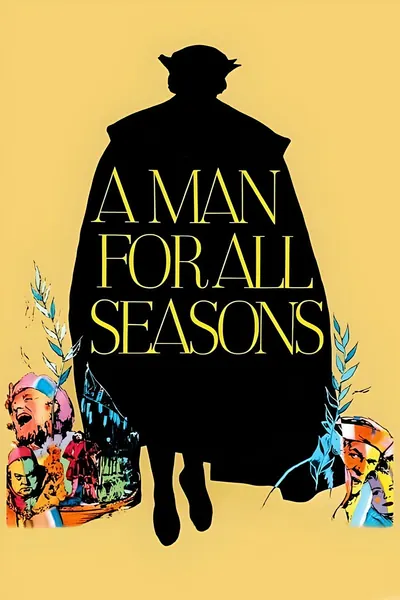
A Man for All Seasons
Directed by Fred Zinnemann
“...a motion picture for all times!”
The story
A depiction of the conflict between King Henry VIII of England and his Lord Chancellor, Sir Thomas More, who refuses to swear the Oath of Supremacy declaring Henry Supreme Head of the Church in England.
What critics & audiences say
 Tomatometer89%Fresh#64 of 98 winners
Famous lines
It profits a man nothing to give his soul for the whole world ... but for Wales?
And when the last law was down, and the Devil turned 'round on you, where would you hide, Roper, the laws all being flat? … Yes, I'd give the Devil benefit of law for my own safety's sake.
…I die His Majesty's good servant, but God's first.
The Duke of Norfolk: …come with us, for fellowship!
More: And when we die, and you are sent to heaven for doing your conscience, and I am sent to hell for not doing mine, will you come with me, for fellowship?
More: Why not be a teacher? You'd be a fine teacher, perhaps a great one.
Richard Rich: If I was, who would know it?
More: You, your pupils, your friends, God. Not a bad public, that.
When statesmen forsake their own private conscience for the sake of their own public duties they lead their country by a short route to chaos.
Sir Thomas More: You threaten like a dockside bully.
Thomas Cromwell: How should I threaten?
More: Like a minister of state, with justice.
Cromwell: Oh, justice is what you're threatened with.
More: Then I am not threatened.
…the maxim of the law is "Silence gives consent". If, therefore, you wish to construe what my silence betokened, you must construe that I consented, not that I denied.
What is an oath then but words we say to God?
I do none harm. I say none harm. I think none harm. And if this be not enough to keep a man alive, then in good faith, I long not to live.
Quotes via Wikiquote
Fun facts
- Vanessa Redgrave played Anne Boleyn in an unbilled cameo on condition she not be mentioned in previews; she appeared 'simply for the fun of it' and refused payment.Wikipedia · Production
- The producers feared Paul Scofield wasn't a big enough name and approached Richard Burton, who turned it down; Laurence Olivier was also considered, but Fred Zinnemann demanded Scofield.Wikipedia · Production
- To keep the budget under $2 million, the actors all took salary cuts; only Scofield, Susannah York and Orson Welles were paid more than £10,000, and John Hurt got £3,000.Wikipedia · Production
- The title comes from Robert Whittington, a contemporary of Thomas More, who in 1520 described him as 'a man of an angel's wit and singular learning... A man for all seasons.'Wikipedia · Title
- The studio's first choices were Alec Guinness for Cardinal Wolsey and Peter O'Toole for Henry VIII, and Robert Bolt wanted director John Huston to play Norfolk, but Huston refused.Wikipedia · Production
- More biographer Richard Marius complained the film turned More into 'a Catholic Abraham Lincoln,' omitting the historical More who wrote polemics 'shrieking for the blood of Protestants.'Wikipedia · Historicity
- John Hurt was cast in his first major film role on the strength of his stage performance in Little Malcolm and His Struggle Against the Eunuchs.Wikipedia · Production
- Made for under $2 million, the film earned $28,350,000 in the US alone, making it the fifth highest-grossing film of 1966.Wikipedia · Box office
- In adapting his own play, Robert Bolt cut the narrating Common Man and split him into several small roles, including the boatman, the jailer, the jury foreman and the executioner.Wikipedia · Adaptation
- Leo McKern and Paul Scofield were the only cast members to appear in both the stage and screen versions, and Vanessa Redgrave later played Lady Alice in a 1988 remake.Wikipedia · Production