Tap to rate
The story
"Patton" tells the tale of General George S. Patton, famous tank commander of World War II. The film begins with Patton's career in North Africa and progresses through the invasion of Germany and the fall of the Third Reich. Side plots also speak of Patton's numerous faults such his temper and habit towards insubordination.
What critics & audiences say
 Tomatometer92%Fresh#49 of 98 winners
IMDb7.9114K votes#46 of 98 winners
Metacritic86/ 100#40 of 93 winners
TMDB7.4/ 10
Famous lines
I want you to remember that no bastard ever won a war by dying for his country. He won it by making the other poor, dumb bastard die for his country.
Rommel... you magnificent bastard, I read your book!
Americans love a winner and will not tolerate a loser. Americans play to win all the time.
A slave stood behind the conqueror, holding a golden crown, and whispering in his ear a warning — that all glory is fleeting.
We're going to kick the hell out of him all the time, and we're going to go through him like crap through a goose!
Thirty years from now when you’re sitting around your fireside with your grandson on your knee, and he asks you: "What did you do in the great World War II?" You won't have to say, "Well, I shoveled shit in Louisiana.
Fixed fortifications are man's monument to stupidity.
Hell, I know I'm a prima donna — I admit it! What I can't stand about Monty is he won't admit it.
Bell: "Nuts!"
Patton: Keep them moving, Colonel. A man that eloquent has to be saved.
Okay. I'll drink to that. One son of a bitch to another!
Quotes via Wikiquote
Fun facts
- George C. Scott won Best Actor for Patton but declined the Oscar, citing a dislike of the voting process and of acting competitions; he was the first actor ever to refuse the award.Wikipedia · Accolades
- Lee Marvin, Burt Lancaster, John Wayne, Robert Mitchum and Rod Steiger all turned down the role of Patton, and Steiger later called it his greatest mistake.Wikipedia · Production
- According to Woodward and Bernstein's The Final Days, Patton was Richard Nixon's favorite film; he watched it repeatedly, and Henry Kissinger wrote that he escaped for an hour in the middle of one screening on the presidential yacht.Wikipedia · Critical response
- George C. Scott initially refused to perform the famous flag speech once he learned it would open the film, fearing it would overshadow the rest of his performance; director Franklin J. Schaffner assured him it would be shown at the end.Wikipedia · Opening
- To avoid an R rating, the writers toned down Patton's real language: in the opening monologue, the word 'fornicating' replaced the actual expletive he used about The Saturday Evening Post.Wikipedia · Opening
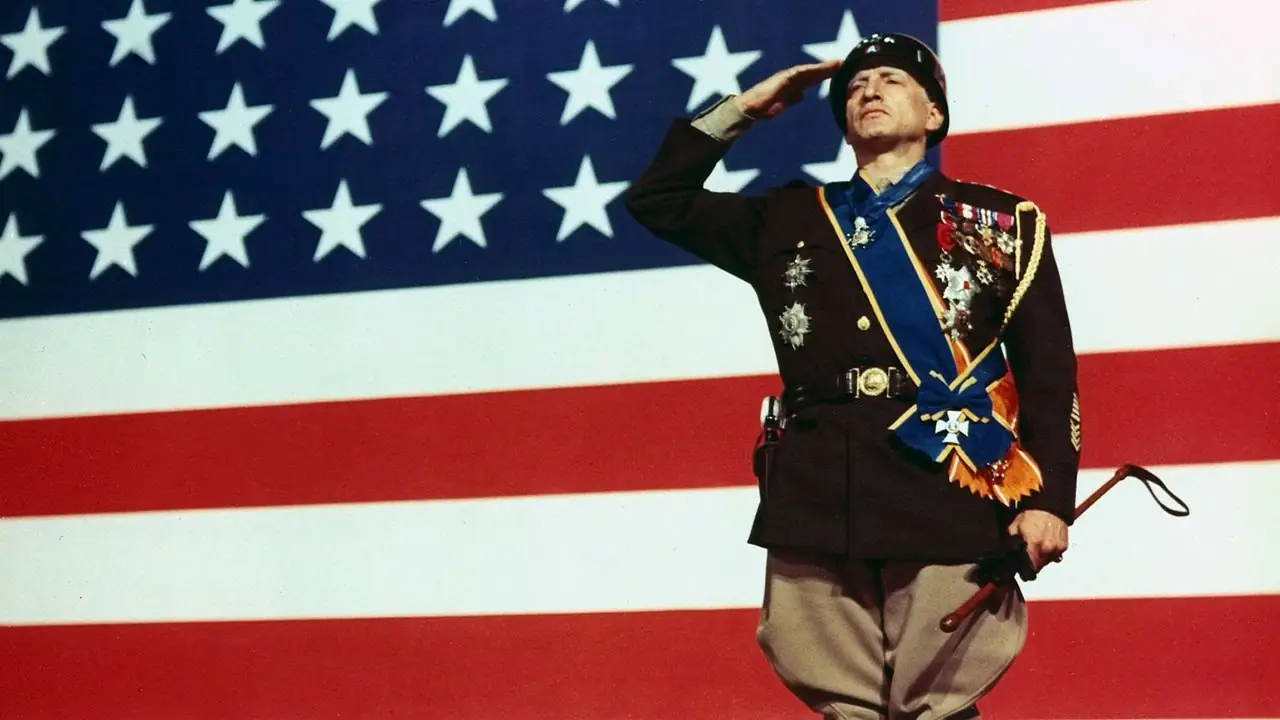
- The giant American flag behind Patton in the opening speech was painted on the back wall of a stage at Sevilla Studios in Madrid, and the whole scene was shot in one afternoon.Wikipedia · Opening
- The screenplay was co-written by a young Francis Ford Coppola, who drafted it in 1963; the film was originally to be called Blood & Guts, with William Wyler set to direct.Wikipedia · Development
- Patton was shot at 71 locations in six countries, mostly in Spain, which had plenty of surplus U.S. Army World War II equipment; the crew rushed to Segovia when snow fell to film the Battle of the Bulge scenes.Wikipedia · Filming
- An unannounced night battle scene filmed near the Royal Palace in Rabat, Morocco, raised fears in the neighborhood that a coup d'etat was under way.Wikipedia · Filming
- Jerry Goldsmith's score used an echoplex to loop trumpet 'call to war' triplets, a musical device meant to represent General Patton's belief in reincarnation.Wikipedia · Music